Noxious News

Noxious News is an update from the San Juan County Noxious Weed Control Program.  Through the seasons we'll highlight weeds, the best strategies for managing them, and fun observations from the field.

Feb 17

Winter Break or Opportunity?

Posted on February 17, 2026 at 12:17 PM by Andrew Munson

January 30, 2026

I bumped into a friend at the grocery store recently.  When they asked how my work was going, they suggested I might be getting a break from the weeds because of the winter season.  The idea was reasonable, and as I began to voice agreement, I u-turned mid-sentence to acknowledge that my back was sore from a busy week of roaming around Lopez frantically removing weeds in all the usual places.

Winter conditions slow plant growth and encourage us to stay indoors, yet it might be the best season to get on top of your noxious weeds for the following reasons:

  1. It’s easier to discover weeds.

Winter is a great time to survey your neighborhood or favorite places for noxious weeds.  Don your coat, grab your phone (with a plant identification app), stuff some gloves inPXL_20260129_220754965 your back pocket, perhaps some binoculars around your neck, and head out the door with a discoverer’s mindset, curiously noticing the details of the landscape. You might be surprised to find a lush tuft of poison hemlock along the fenceline, some wispy green Scot’s broom along your driveway, or the broad rhododendron-like leaves of spurge laurel hunkered beside a dormant thicket of nootka rose.

  1. It’s easier to remove them.

With the ground softened by rain, pulling weeds out by the root is easier while disturbing less soil that could encourage a flush of seedlings.  Spikey bull thistle can be dispatched with a shovel placed at the base of the plant, then slicing the taproot off below the surface (no bending required!).  If you have a large patch and are considering using herbicidal tools, a dry winter day can be the ideal time for a targeted treatment, as many native plants nearby are dormant.  Often less herbicide will be required for the job because some species are just beginning their growth period.  If using herbicide, take care to select an appropriate product and follow the label closely.  Contact the Noxious Weed Control Department for more information.

  1. You likely have more free time in the winter.

 Spring gardening is right around the corner.  Your cousin, grandma, friend, parents, kids, grandkids, and grandpets are all planning to visit you when the weather gets nicer.  Maybe you have your own trips scheduled or that remodeling project.   You’re going to be busy!   If you’re hiring help to deal with your invasive plants, local landscape contractors may have more availability in winter.  Plus some winter fresh air and exertion will keep you in shape.

Use this winter to get ahead of your weeds before the growing season hits.  Check out the San Juan County noxious weed list and contact us to learn more about the best strategies for dealing with your weeds.  

Thanks for pulling together to keep our special islands thriving.  See ya out there!   

Feb 17

Keeping Out of The Bind

Posted on February 17, 2026 at 11:08 AM by Andrew Munson

November 25, 2025

As staff members of the San Juan County Noxious Weed Program, we find ourselves in a number of backyards, fields, and forests, puzzling over the toughest invasive plants, striving to assist residents in coming up with management plans that work for their goals and resources.  

Recently I was invited to the home of an exasperated gardener to behold their veggie dreams infested with field bindweed (Convolvulus arvensis). A member of the morning glory family, field bindweed is a vigorous, herbaceous vine that sprawls across the ground in search of a scaffold to climb (your carrot tops should do!). As it constricts up the stem of the host, it produces a flush of leaves that compete for light, then an array of white, satellite-shaped flowers about the size of a quarter, and finally a sprinkling of loooong-lived seed. Below ground the bully excels in root and shoot development that allows the plant to survive many a furious surface weeding. In the late summer when the grass has been brown for weeks, bindweed is green, lush, and blooming! In the late stages of bindweed's reign, it can cover a garden like ivy in a miniature city park.  Photo of field bindweed in bloom climbing up grass.
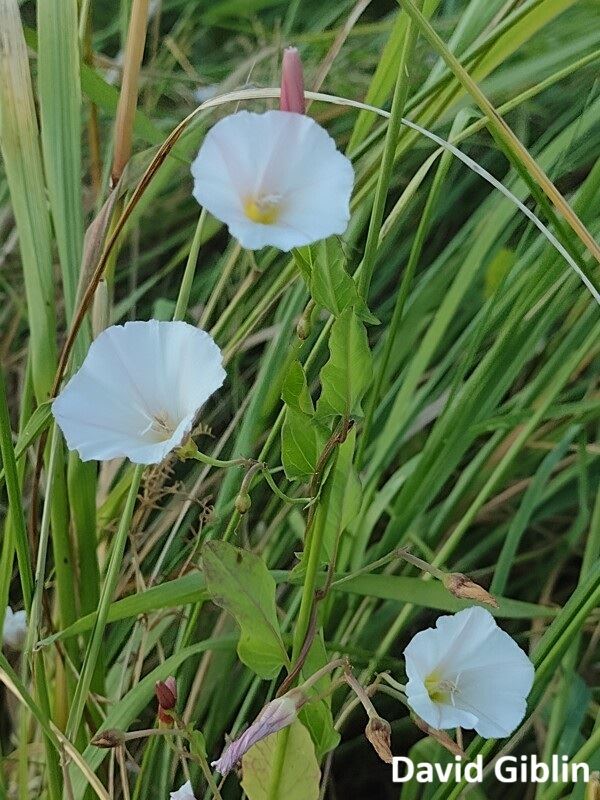
You don't want it.  Bindweed is known as one of the toughest noxious weeds to manage once it gets established.  Prevention is key, so research the origin of hay, mulch, soil, cover crop seed, transplants, or the heavy equipment you introduce to your parcel.  Buy from tidy operations or knowledgeable vendors that strive to prevent contamination of their products with viable seed.

You have it.  Vigilance is key to save yourself time and toil in the long run.  Come up with a system to survey known bindweed sites and routinely weed them out...ruthlessly.  You may have a shot at eradication at this stage, and wouldn't that be nice! 

You REALLY have it.  Don't panic, but please don't visit me without donning your hermetically-sealed onesie (mostly kidding, but leave your seed-infested boots at home).  There are legends of some gardeners bringing these spaces back from the brink, but the goal at this stage is developing systems for living with bindweed rather than fantasizing about eradication.  Consider abandoning the most infested areas and focus your gardening in easier locations.  Mow or cover heavy infestations to reduce seed production.  Avoid soil disturbance, which can activate a latent seed bed and propagate tilled fragments, and become a practitioner of low-till growing techniques.  Durable, UV-resistant, easily-movable covers (sufficiently weighed or pinned down from the wind!) can be useful tools for managing aisles and edges, as bindweed weaves and winds its way to the surface in porous wood mulch or between the seams and rips of cardboard.  Plastic barriers will need to be lifted and reset periodically to keep them from being hopelessly anchored by weed and grass seed germinating on top and growing down through the barrier to the soil.

Look-alike Alert!  Don't be a fool (like me) and freak out about field bindweed's much less threatening doppelganger:  black bindweed AKA wild buckwheat AKA Fallopia convolvulus.  Check out these photos on the UW Burke Herbarium site.  Hedge bindweed (Calystegia sepium), also strikingly similar, is a weedy native found in the islands.

Check out this source from WSU Extension for more information about bindweed and control strategies.

Have you succeeded in getting the upper hand on bindweed?  PLEASE share your management system with us, so we can spread the good word.  Also get in touch if you would like no-cost identification or management assistance:  noxiousweeds@sanjuancountywa.gov, 360-376-3499. 

Thanks to Caitie Blethen and Rebecca Moore of the WSU Extension, and to the San Juan County Master Gardeners who shared their experience finding themselves in the bind (weed).

Feb 17

Let No Weed Go To Seed

Posted on February 17, 2026 at 11:07 AM by Andrew Munson

July 8, 2025

I'm a big fan of low-hanging fruit.  No ladder or climbing needed.  Just lazily wander over and pop the sweet treats in your mouth.  #Winning!

The metaphor works for so many things, even invasive plants!  As a tiny team of 3 staff members covering the county, we count on YOU to take action on noxious weeds for theIMG_0251 benefit of your neighbors, and in stewardship to our special island home.  With that in mind, we're here to support you, and remind you that you don't need fancy tools, abundant spare time, nor physical prowess to take action.  

The low-hanging fruit of the noxious weed world is in preventing the buggers from going to seed, which they are BUSY doing at this time of the year.  Since a single plant can produce thousands of seed that can sprout for years to come, your goal is to simply nip off their seed-producing flowers, heads, or branch tips.  Do this with gloved hands and a sharp tool, as some species are poisonous.  Often this work can be done at waist height (no bending over!).  In this way, one person can move through a patch in minutes and have a BIG impact.

Depending on your location and timing, your noxious weeds may already be close to dropping seed or already shedding seed.  It's best to put those bits in a plastic trash bag and take them to your transfer station for FREE disposal.  Hot Tip:  Just bring the seed producing parts of the plant to the dump to save you time and garbage bags.   Leave the rest of the plant to dry up and decompose on site.

hemlock pow

Another poison hemlock factory snuffed out in seconds by a watchful citizen!

scotch broom clang

There's still time to get a C in your Invasive Plant Management class by taking a moment to lop off the seedpod-producing branches of your Scotch broom plants.  I'll consider you for a B if you dive in and nip the sucker off at soil level.  When Scotch broom pods turn black and brittle, the pod ruptures, spreading seed far from the source.  Please DO NOT TRANSPORT Scotch broom debris that is actively scattering seed.

teasel biff

When it comes to noxious weeds like common teasel, your granny was right!  An ounce of prevention IS worth a pound of cure!  Take a second now to deal with your weeds before they get a chance to send their seed off to your neighbor's yard.

tansy kblammm

Consider the term "K-BLAMMM" in the context of tansy ragwort.  It clearly communicates a one-two punch, which is what this character requires when it's in bloom.  First clip and bag the flower heads, then yank the stalk out by the root.  If you just "BLAMMM," the uprooted tansy is likely to have enough energy to create seed when your back is turned.  

Did I lose you?  Visit the "Resources" tab for species-specific control strategies or contact the San Juan County Noxious Weed Control Department for more support:  noxiousweeds@sanjuancountywa.gov or 360-376-3499.

Thank you for making a little time today to keep invasive plants in check!